Seamless Retro Fruit Floral Patterns: A Practical Guide to Vintage Design Assets
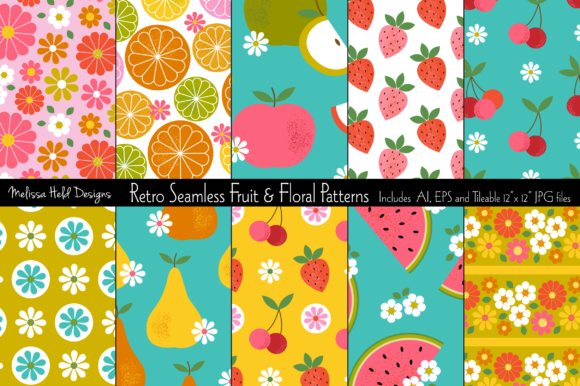
There is a distinct warmth to vintage aesthetics that modern minimalism often lacks. For designers, crafters, and small business owners, finding the right texture can define an entire project. Seamless Retro Fruit Floral Patterns offer a specific nostalgic charm, combining the organic softness of botanical illustrations with the playful vibrancy of mid-century produce art. This collection features ten unique designs showcasing cherries, apples, pears, citrus, watermelon, and strawberries alongside delicate floral accents. However, owning these assets is only the first step. The true value lies in understanding how to leverage their technical specifications and aesthetic nuances to avoid common design pitfalls that can make professional work look amateurish or homemade.
Understanding the Technical Foundation
Before applying these patterns to gift wrap, textiles, or stationery, it is vital to understand what you are actually working with. Each file in this set is designed at 12 x 12 inches, a standard dimension for scrapbooking and digital paper. Crucially, every JPG is conveniently tileable at this exact size. Many creators mistakenly assume "seamless" simply means the edges match visually. In professional workflows, true seamlessness requires mathematical precision where the pattern repeats infinitely without visible grid lines or color shifts.
This collection provides three distinct file formats to ensure versatility: 10 editable AI files, 10 editable EPS files, and 10 high-resolution JPGs. A frequent oversight among beginners is relying exclusively on the JPG versions because they are easier to open. While excellent for quick mockups or digital backgrounds, JPGs are raster-based. If you need to adjust the scale of a strawberry motif for a large-format textile print or change the background hue to match a specific brand palette, the raster file will limit you. Utilizing the vector-based AI and EPS files allows for infinite scaling and color manipulation without quality loss. Always assess your final output medium before selecting your file type to prevent pixelation or unnecessary rework.
Avoiding Color and Print Mismatches
Retro fruit motifs are celebrated for their saturated, cheerful palettes, but this vibrancy presents a challenge when transitioning from screen to physical media. Digital displays use additive RGB color, while printers and textile manufacturers use subtractive CMYK or Pantone systems. A common mistake is designing a beautiful scrapbook page or product label on-screen using the provided JPGs, only to find the printed result looks muddy or desaturated. The bright red of a vintage cherry or the zesty yellow of a lemon often falls outside the printable gamut of standard home printers.
To mitigate this, use the editable AI or EPS files to perform a soft-proof check before finalizing your design. If you are creating home decor items like throw pillows or tablecloths, request a physical swatch or test print first. The expanded pattern layer included in each file is particularly useful here. It allows you to isolate specific elements to test color accuracy independently of the full repeat. By validating colors early, you avoid costly reprints and ensure the retro aesthetic translates faithfully to the tangible product.
Scale and Contextual Appropriateness
Just because a pattern tiles perfectly at 12 x 12 inches does not mean that scale is appropriate for every application. A dense arrangement of pears and flowers might look exquisite on a greeting card but could become visually overwhelming when used as wallpaper or upholstery fabric. Conversely, a sparse citrus pattern might feel elegant on packaging but look empty and unfinished on a small business card. One of the most frequent usability errors is failing to adjust the pattern scale relative to the physical dimensions of the end product.
When using the vector files, take advantage of the editability to resize the master swatch. For smaller stationery items, reducing the pattern scale by 50% or 75% can create a more refined, sophisticated texture that supports typography rather than competing with it. For larger applications like gift wrap or bedding, maintaining the original 12-inch repeat or even enlarging it can provide the bold statement typical of authentic retro design. Always create a life-size mockup or print a test section at actual size to evaluate visual weight before committing to production.
Layer Management and Workflow Efficiency
Efficiency separates hobbyists from professionals. Each file in this set includes both an expanded pattern layer and a swatch layer. Beginners often flatten these layers immediately or ignore the swatch entirely, treating the file as a static image. This approach severely limits future flexibility. The swatch layer contains the fundamental building block of the seamless repeat. Keeping this layer intact and organized allows you to regenerate the pattern if you modify individual elements, such as changing all green leaves to olive tones for an autumn variation.
Furthermore, proper layer management prevents accidental edits to the repeat structure. When customizing these Seamless Retro Fruit Floral Patterns, lock the base pattern layer and create new adjustment layers above it. This non-destructive workflow ensures that if a client requests a revision or you want to repurpose the design for a different season, you aren't starting from scratch. Ignoring this organizational step leads to fragmented asset libraries and wasted hours recreating variations that should have taken minutes to generate.
Evaluating Quality Before Purchase
Whether you are adding this specific set to your library or evaluating similar vintage-inspired assets, knowing what to inspect is crucial. Do not rely solely on the thumbnail preview. Zoom in to 100% to check for artifacts, jagged edges on fruit outlines, or inconsistent spacing between motifs. True seamless patterns should show no evidence of the tile boundary even at high magnification. Additionally, verify the color mode and resolution listed in the product details. For print-ready retro designs, 300 DPI at actual size is the minimum standard; anything less will appear soft or blurry in physical form.
Also, consider the licensing terms relative to your intended use. If you plan to sell products featuring these patterns, such as branded stationery or textile goods, confirm that the license permits commercial end-products versus mere digital redistribution. Understanding these parameters upfront protects your business from legal complications and ensures you select assets that align with your entrepreneurial goals. By approaching Seamless Retro Fruit Floral Patterns with technical awareness and strategic foresight, you transform simple decorative elements into powerful, professional-grade design tools that elevate every project they touch.