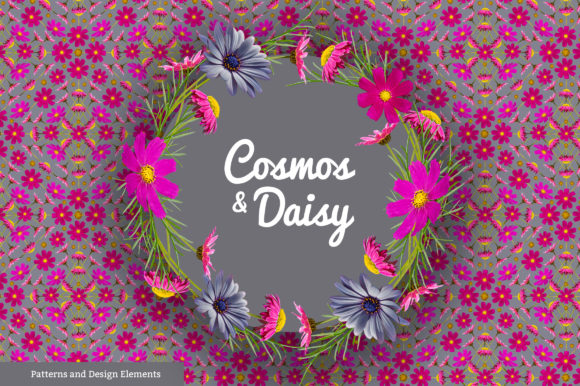
Cosmos and Daisy Floral Patterns: A Strategic Asset for Visual Branding and Design Efficiency
In the competitive landscape of visual communication, the distinction between generic decoration and strategic design often determines market perception. The Cosmos and Daisy Floral Patterns collection serves as more than a simple repository of botanical imagery; it functions as a foundational asset library for professionals seeking to balance aesthetic warmth with operational efficiency. For entrepreneurs, marketers, and designers, this resource addresses a critical bottleneck in creative production: the need for high-quality, cohesive visual elements that can be deployed rapidly across multiple touchpoints without sacrificing brand integrity.
This specific project comprises 21 seamless patterns saved in JPEG formats and eight variations in PNG with transparent backgrounds, alongside 23 distinct design elements including three pre-made arrangements and a wreath. Understanding the technical specifications is merely the starting point. The true value lies in leveraging these assets to support broader business goals, from packaging design and textile manufacturing to digital stationery and corporate branding. By treating these floral assets as modular components of a larger visual system, decision-makers can reduce production timelines while maintaining a consistent narrative that resonates with target audiences who value organic, approachable aesthetics.
Aligning Botanical Assets with Brand Positioning
The choice of cosmos and daisies is not arbitrary; it carries specific semiotic weight that must align with your brand’s positioning strategy. Unlike roses or orchids, which can signal luxury or romance, cosmos and daisies communicate accessibility, resilience, and natural simplicity. When integrating Cosmos and Daisy Floral Patterns into a branding project, consider whether your product or service benefits from this specific emotional association. For wellness brands, educational platforms, or sustainable product lines, these flowers reinforce messages of growth and authenticity. However, for high-tech or ultra-luxury sectors, the application requires careful moderation to avoid undermining perceptions of precision or exclusivity.
Strategic use involves mapping these patterns to specific customer journey stages. The seamless JPEG patterns are ideal for background applications where texture is needed without distracting from primary content, such as website headers or packaging interiors. Conversely, the isolated PNG elements serve as focal points for call-to-action buttons, social media overlays, or product labels. This differentiation ensures that the floral motifs support the hierarchy of information rather than competing with it. Before implementation, audit your existing visual identity to ensure the color palette and line weight of these assets complement your typography and logo usage guidelines.
Operational Efficiency in Multi-Channel Design
One of the most significant advantages of utilizing a comprehensive set like Cosmos and Daisy Floral Patterns is the standardization it brings to cross-platform design workflows. Small business owners and freelancers often struggle with visual inconsistency when creating assets for disparate channels. Having a unified library of 21 seamless patterns and 23 coordinated elements eliminates the guesswork involved in sourcing matching graphics from different vendors. This cohesion is essential for building brand recognition over time.
Consider the practical application in packaging design. The seamless patterns provide immediate coverage for boxes, tissue paper, or shopping bags, reducing the need for custom illustration work that can cost thousands of dollars and take weeks to complete. Meanwhile, the pre-made arrangements and wreath offer ready-to-use solutions for seasonal campaigns or limited-edition releases. This modularity allows teams to iterate quickly on mockups and prototypes. When planning a product launch, having these assets on hand enables marketing teams to produce social media teasers, email newsletters, and physical collateral simultaneously, ensuring a synchronized go-to-market strategy.
- Packaging Design: Utilize seamless JPEGs for full-wrap prints and PNG elements for spot UV accents or label framing.
- Textile and Apparel: Leverage the repeat patterns for fabric printing, ensuring the scale is adjusted appropriately for the garment type.
- Stationery and Publishing: Apply transparent PNG elements to book covers, journals, or greeting cards to create depth without obscuring text.
- Digital Branding: Use subtle pattern overlays on web backgrounds to add tactile quality to flat screens, improving user engagement through sensory suggestion.
Mitigating Risks Through Intentional Application
While pre-made assets offer undeniable speed, relying on them without clear intent introduces risks. The primary danger is visual saturation; using too many floral elements can make a design feel cluttered or amateurish. Another risk is contextual dissonance, where the cheerful nature of daisies clashes with serious or somber messaging. To mitigate these issues, establish strict usage guidelines before deploying Cosmos and Daisy Floral Patterns. Define negative space requirements to ensure readability and visual breathing room. Determine maximum opacity levels for background patterns so they remain supportive rather than dominant.
Furthermore, consider the long-term lifecycle of the designs. Trends in floral illustration evolve, and what feels fresh today may appear dated in two years. Strategic planning involves identifying which assets are timeless versus trendy within the collection. The isolated photographs and realistic elements tend to have longer shelf lives than stylized vector interpretations. By anchoring your core brand identity in the more neutral, photographic elements and reserving the bolder patterns for temporary campaigns, you protect your brand equity against premature aging. This approach transforms a static asset pack into a dynamic toolkit capable of supporting both evergreen content and timely promotions.
Technical Considerations for Professional Output
Understanding file formats is crucial for maximizing the utility of this collection. The inclusion of both JPEG and PNG files serves distinct production needs. The 21 seamless JPEG patterns are optimized for continuous surface coverage, making them efficient for large-format printing and digital backgrounds where transparency is unnecessary. Their compression balances quality with file size, facilitating faster load times for web use and smoother handling in layout software. However, JPEGs do not support transparency, meaning they cannot be layered effectively over colored backgrounds without masking.
The eight PNG patterns and 23 design elements with transparent backgrounds solve the layering challenge. These are essential for composite designs where the floral motif must interact with other graphical elements or photography. When working on textile design or packaging, verify the resolution of these PNGs meets print standards (typically 300 DPI at final output size). While digital use is forgiving, print production demands precision. Always test a sample swatch before committing to a full run. Additionally, the three pre-made arrangements and wreath should be treated as starting points rather than final solutions. Customizing these compositions by adjusting spacing, adding text integration, or combining them with other elements prevents the "template look" that can diminish perceived brand value.
Enhancing Customer Experience Through Sensory Design
Beyond aesthetics and efficiency, Cosmos and Daisy Floral Patterns play a role in shaping customer experience. In an increasingly digital marketplace, tactile and organic visuals provide a psychological anchor that suggests care and human touch. For educators and publishers, these patterns can soften academic or instructional materials, making them more inviting and reducing cognitive load for learners. For small business owners, the consistent use of these florals across unboxing experiences creates a memorable ritual that encourages social sharing and word-of-mouth referrals.
However, this sensory impact must be calibrated to audience expectations. Conduct informal testing with representative users to gauge reactions. Does the pattern density feel overwhelming or comforting? Do the colors evoke the intended seasonal or emotional response? Feedback loops are essential for validating design decisions. Document successful applications and note areas where the assets underperformed. Over time, this data informs smarter purchasing and utilization strategies, ensuring that future investments in design resources yield measurable returns in engagement and conversion.
Strategic Planning for Long-Term Asset Value
To extract maximum value from Cosmos and Daisy Floral Patterns, integrate them into your annual content and product planning cycles. Rather than using assets reactively, map them to key business milestones. Schedule pattern-heavy designs for spring and summer campaigns when botanical themes naturally align with consumer sentiment. Reserve isolated elements for year-round branding touches that require subtlety. Create a style guide specifically for floral usage that outlines approved combinations, prohibited pairings, and scaling rules. This documentation ensures consistency even as team members change or external contractors are hired.
Finally, view this collection as part of a broader ecosystem of creative resources. It solves specific problems related to organic, feminine, or natural branding but should be supplemented with complementary assets for contrast and variety. Pairing these soft florals with bold typography, geometric shapes, or solid color blocks creates visual tension that keeps designs modern and engaging. The goal is not to let the patterns define the brand entirely, but to use them as a versatile instrument in a well-orchestrated visual strategy. By approaching Cosmos and Daisy Floral Patterns with this level of intentionality, professionals transform a simple graphic resource into a catalyst for cohesive, effective, and enduring brand communication.