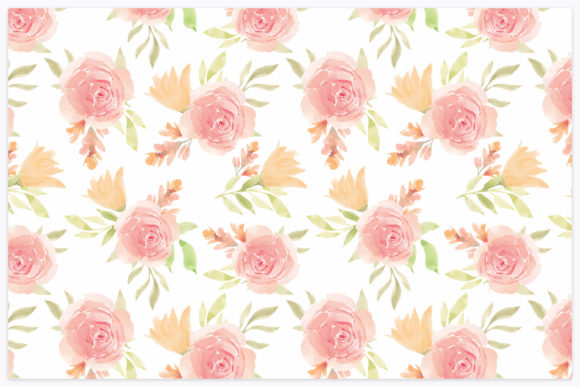
Seamless Pattern with Floral Watercolor: Elevating Modern Digital and Print Design
The intersection of traditional artistry and digital utility has never been more pronounced than in the current demand for high-quality surface design. A seamless pattern with floral watercolor represents more than just a decorative background; it serves as a versatile bridge between organic aesthetics and functional commercial application. In an era where visual saturation is high, the soft, translucent nature of watercolor offers a necessary respite, providing texture and depth that flat vector graphics often lack. This specific aesthetic has evolved from a niche artistic preference into a staple for professionals ranging from textile designers to digital marketers seeking to humanize their brand identity.
Understanding the relevance of this asset requires looking beyond the image itself. When creators utilize a seamless pattern of watercolor flower designs, they are tapping into a broader cultural shift toward biophilic design and authentic craftsmanship. Audiences are increasingly responsive to visuals that feel hand-touched and imperfectly perfect. Whether applied to summer holiday templates or sophisticated fabric designs, these patterns satisfy a dual need: they provide immediate visual appeal while maintaining the technical precision required for professional production. The value lies not just in the beauty of the bloom, but in the repeatability and scalability of the file structure.
The Evolution of Botanical Aesthetics in Digital Workflows
Historically, incorporating watercolor textures into repeatable designs was a labor-intensive process involving physical scanning, manual color correction, and complex tiling in raster software. Today, the workflow has shifted dramatically. Modern creators expect assets that respect the origin of the medium while accommodating the speed of digital production. The evolution of the seamless pattern of watercolor flower reflects this change. We have moved away from stiff, obviously tiled repetitions toward fluid compositions where the transition points are invisible to the naked eye.
This shift is driven by changing user expectations across multiple industries. In web design, full-screen backgrounds must load quickly without pixelation on retina displays. In fashion, print engineers require files that maintain color fidelity across different substrates. Consequently, the modern floral pattern is no longer treated as mere clip art; it is viewed as a foundational design system. Professionals are paying closer attention to these assets because they solve specific problems: they add complexity to minimalist layouts, provide thematic consistency for seasonal campaigns, and offer a cost-effective alternative to commissioning bespoke illustrations for every new project.
Technical Specifications and Professional Utility
For entrepreneurs, freelancers, and business owners, the technical integrity of a design asset is just as important as its aesthetic quality. A beautiful pattern is useless if it cannot be scaled for a billboard or edited for a business card. This is why the inclusion of specific file formats is critical for practical application. When acquiring a seamless pattern with floral watercolor, understanding what is included ensures the asset fits your workflow.
- Pattern in .EPS 10 Format: Encapsulated PostScript (EPS) remains the industry standard for vector-based and hybrid workflows. Version 10 compatibility ensures that the file opens reliably across various versions of Adobe Illustrator, CorelDRAW, and Affinity Designer. For professionals, this format allows for non-destructive editing. You can adjust colors, isolate elements, or resize the pattern tile infinitely without losing edge definition. This is essential for fabric designs where scale varies significantly between garment types.
- Pattern in .JPG 4167 x 4167 Pixel Format: High-resolution raster files are indispensable for immediate use and digital applications. At 4167 x 4167 pixels, this JPG provides ample resolution for large-format printing at 300 DPI, covering approximately 13.8 inches square. This size is particularly relevant for wallpapers and poster designs. For digital creators, this resolution ensures crisp rendering on high-density screens while remaining manageable for web optimization. It serves as a ready-to-use solution for those who do not require vector manipulation.
Practical Applications Across Creative Industries
The versatility of a floral watercolor pattern stems from its ability to adapt to context. Unlike rigid geometric patterns, organic florals carry an emotional resonance that can be tuned to fit diverse projects. Below are realistic examples of how these assets are currently being deployed by professionals and hobbyists alike.
Fabric Design and Fashion Textiles
In the textile industry, the seamless nature of the pattern is non-negotiable. Designers use the EPS format to create colorways for different seasons. A watercolor floral might serve as a vibrant, saturated print for a summer dress line, while the same base pattern could be desaturated and overlaid with grain for a muted autumn collection. The high resolution ensures that the delicate bleeding edges characteristic of watercolor remain sharp when printed on silk, cotton, or linen. Furthermore, because watercolor inherently possesses transparency, it layers beautifully over dyed fabrics, creating depth that solid ink prints cannot achieve.
Summer Holiday Templates and Seasonal Marketing
Marketers and content creators face the constant challenge of keeping seasonal content fresh. A seamless pattern with floral watercolor acts as an efficient theming engine for summer holiday templates. Instead of designing new assets from scratch for every social media post, email newsletter, or event invitation, brands can establish a cohesive visual language using a single pattern. The soft, airy quality of watercolor aligns perfectly with summer associations of lightness and relaxation. By utilizing the JPG format, bloggers and social media managers can quickly apply these backgrounds to Canva templates or Photoshop mockups, reducing turnaround time while maintaining a premium, custom look.
Wallpapers and Interior Surfaces
Interior design and digital wallpaper creation demand high fidelity. The 4167 x 4167 pixel specification is specifically advantageous here. For physical wall coverings, this resolution supports large-scale repeats without visible degradation. In digital spaces, such as desktop or mobile wallpapers, the intricate details of watercolor brushwork prevent the image from looking flat or artificial. Users seeking to customize their devices or living spaces appreciate the organic variation in watercolor patterns, which reduces visual fatigue compared to high-contrast, repetitive geometrics.
Stationery, Cards, and Packaging
For stationers and packaging designers, the tactile implication of watercolor is a selling point. Even when printed digitally, a high-quality seamless pattern of watercolor flower designs suggests artisanal care. This is vital for wedding invitations, greeting cards, and boutique product packaging. The EPS format allows designers to extract individual floral elements to create coordinating borders or focal points, ensuring the entire suite of materials feels unified. The ability to manipulate the vector data means text can be integrated directly into the pattern flow, rather than simply sitting on top of it, resulting in more sophisticated typography treatments.
Navigating Trends Without Compromising Longevity
While floral patterns are perennial, the specific execution trends cycle frequently. Currently, there is a move away from hyper-saturated, tropical aesthetics toward softer, heritage-inspired botany. However, investing in a seamless pattern with floral watercolor is a strategic choice precisely because of its timelessness. Watercolor as a medium transcends fleeting fads. To maximize the longevity of this asset, users should focus on color grading and composition rather than the motif itself.
Professionals are advised to treat the base pattern as a neutral canvas. By adjusting hue and saturation in post-production, a single watercolor floral asset can span multiple trend cycles. For instance, shifting the palette to earth tones makes it relevant for sustainable branding, while brightening the values adapts it for Gen Z-focused marketing. This adaptability is what separates a useful design tool from a disposable graphic. The key is to leverage the technical flexibility of the included EPS and high-res JPG files to future-proof your creative library.
Best Practices for Implementation
To get the most out of these assets, consider the following practical recommendations grounded in professional experience:
- Test Print Before Production: Watercolor relies on subtle gradients. Screen calibration varies, so always print a swatch at actual size to verify that the lighter washes hold detail and the colors translate accurately to your chosen substrate.
- Mind the Scale: A pattern that looks appropriate on a phone screen may be overwhelming on a sofa upholstery or too small on a business card. Use the EPS file to test multiple scales before finalizing your layout.
- Layer Intentionally: Avoid placing heavy black text directly over detailed floral areas. Utilize the negative space within the seamless pattern or apply a semi-transparent overlay to ensure readability and accessibility compliance.
- Optimize for Web: While the 4167 x 4167 JPG is excellent for print, always export a compressed, resized version for website backgrounds to maintain fast load times and good Core Web Vitals scores.
Ultimately, a seamless pattern with floral watercolor is a functional creative instrument. It combines the enduring appeal of hand-painted botany with the rigorous demands of modern production. Whether you are designing a summer capsule wardrobe, refreshing a blog’s visual identity, or creating bespoke stationery, the combination of editable vector data and high-resolution raster imagery provides the freedom to execute your vision with both efficiency and artistry. By understanding the technical specifications and contextual applications of these files, creators can transform a simple pattern into a cornerstone of their design strategy.